

This article explores the new challenges posed by AdBlue consumption for professionals in complying with current legislation on reducing pollutant emissions. Since 2006, AdBlue has been a colorless additive used in diesel vehicles to reduce nitrogen oxide emissions and pollution. Combined with the SCR system , and essential to its operation, it is now required on all diesel trucks and machinery, which must now be equipped with an AdBlue tank .

How to calculate the AdBlue consumption of your vehicles
Unsurprisingly, the main sectors consuming AdBlue are related to transportation, whether it be vans or trucks in road transport or various types of machinery in the agricultural and forestry sectors. Their use is so widespread that it is now essential to carefully manage consumption to avoid soaring operating costs due to rising prices.
How to calculate your consumption?
To determine this, carriers and companies must calculate their needs based on their vehicle types: 3 to 5% for heavy goods vehicles, 4 to 10% for cars and 5 to 7% for agricultural tractors.
To calculate your AdBlue consumption for trucks, heavy goods vehicles, and agricultural machinery, multiply the diesel . This average may be lower depending on the type of vehicle. You can also use online simulators offered by some AdBlue manufacturers,which provide a rough estimate, but nothing beats manual calculation, especially for fuel consumption.
How many kilometers can I get with a full tank of AdBlue?
To calculate the number of kilometers with a full tank of AdBlue, there are a few parameters to take into account, such as the size of the tank.
The average AdBlue tank capacity for a truck varies depending on the vehicle's size and usage. Generally, the tank capacity for a heavy goods vehicle is between 50 and 100 liters. In the case of the Mercedes Actros, for example, it's between 75 and 90 liters.
However, some truck models may have tanks with a capacity higher or lower than this range. This is therefore something to check.
Then there's the diesel tank capacity of a truck, which averages between 300 and 800 liters. AdBlue consumption in trucks, like fuel consumption, depends on various factors such as the model, engine size, load, driving style, and road conditions.
For example, let's say your truckconsumes an average of 6 liters of AdBlue per 100 liters of diesel, and 34 liters of diesel per 100 km traveled. The fuel tank has a capacity of 600 liters and the AdBlue tank has a capacity of 80 liters.
For a diesel fill-up, your truck travels:
600 / 34 = 17 – 17 * 100 KM = 1700 Km on average with a full tank of fuel.
Distance = (AdBlue capacity / (AdBlue consumption / 100 liters of fuel)) * 100 km / Fuel consumption per 100 km
Distance = (80 / (6 / 100)) * 100 / 34
Distance = 4000 km
That's an average of 4000 km on a full tank of AdBlue. Please note, this example is used for simple comparison; in real-world situations, the result can vary considerably.
How can I find out the level of my tank?
The AdBlue tank level in a heavy goods vehicle can be determined using a special level indicator installed on the tank. In some cases, the tank level can be checked via a control screen on the vehicle's dashboard or on-board computer. It is also possible to measure the tank level using an ultrasonic probe, which is installed on the tank and can provide an accurate reading of the fluid level.
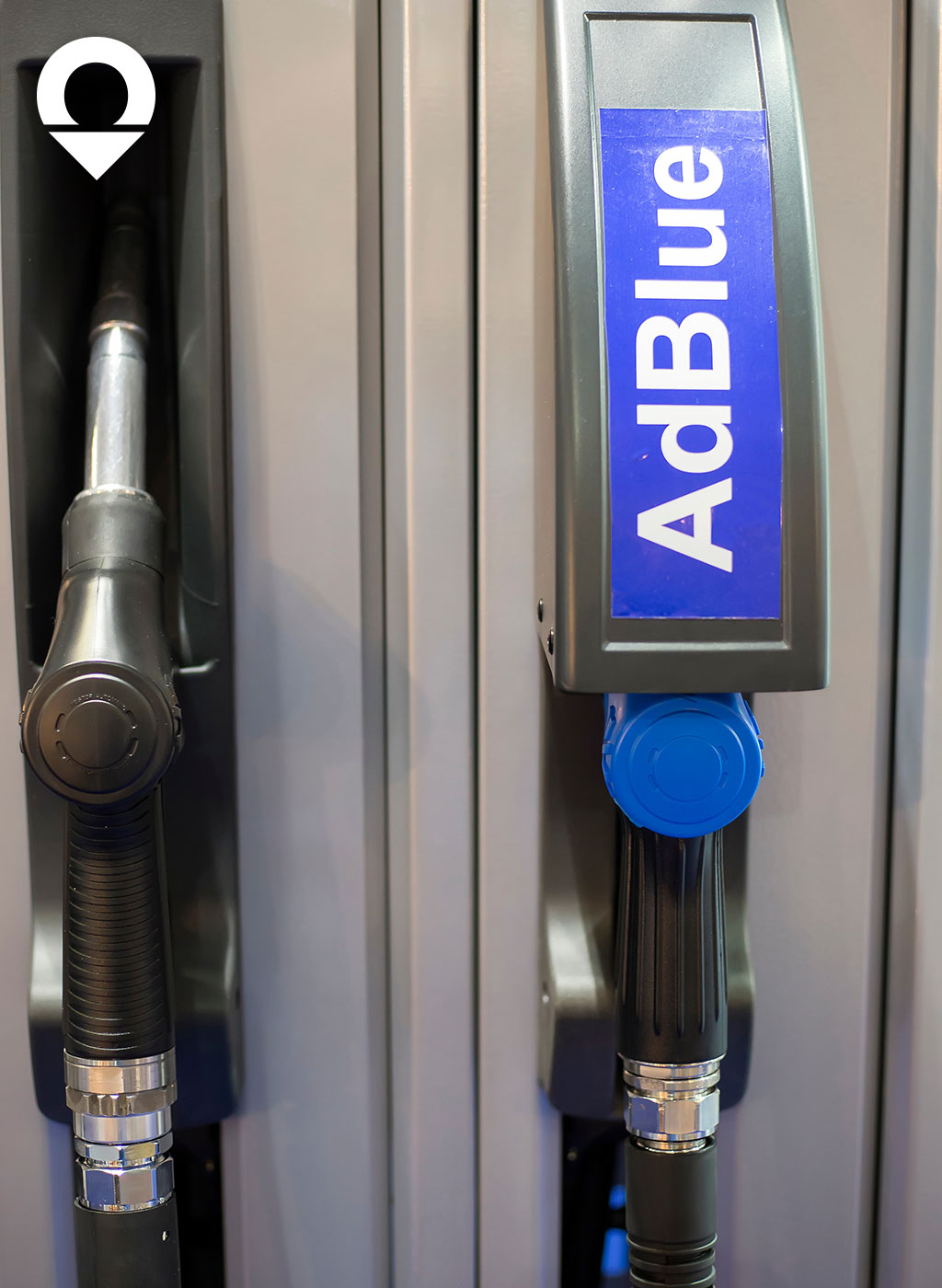
What are the impacts of AdBlue consumption on professionals?
The use of AdBlue by professionals has been growing rapidly for several years. This pollution control solution has become essential for the transport sector and now represents a significant portion of professionals' expenses. Indeed, it allows diesel vehicles to reduce their NOx and particulate emissions, which contributes to improving air quality and meeting environmental regulations. AdBlue consumption also has positive consequences for engine performance : when combined with the SCR system, it has enabled professionals to achieve some fuel savings and reduce their operating costs , at least initially
Financial stakes for professional activities
AdBlue represents a significant financial challenge for businesses, particularly the road transport and agricultural sectors, which are major consumers. Indeed, for several years now, AdBlue prices have been steadily increasing, directly impacting companies' operating costs. Consumers are therefore constantly searching for the best deals to reduce their expenses. Companies in these sectors thus face a major financial challenge: finding a way to reduce their operating costs without compromising their service quality.
An organization to be put in place
The price of AdBlue has increased considerably recently, highlighting the need to implement cost-reduction measures such as purchasing larger quantities. This inevitably requires adjustments and a different organizational structure. Many professionals have had to purchase AdBlue storage tanks, allowing businesses to order in bulk, starting at 3,000 liters, and therefore at more advantageous prices.
In addition, the tanks are generally equipped with a control and monitoring system that maintains the tank at an optimal level and will alert the user if there is a need to refill.
It also offers better security of supply, better inventory management and greater accuracy when monitoring levels in vehicles.
How to reduce your AdBlue consumption?
In conclusion, we present two effective solutions to reduce your Adblue consumption by decreasing your fuel consumption.
Eco-driving and maintenance
The first step is to adopt eco-friendly driving habits. Smooth and careful driving can help reduce fuel consumption and, consequently, AdBlue consumption. Drivers can also reduce consumption by using lower gears and avoiding harsh acceleration and braking.Regular maintenance also helps ensure the vehicle runs optimally and consumes as little fuel/AdBlue as possible. Diesel particulate filters and spark plugs should be replaced regularly, and all other components should be inspected and maintained.
The ECOLOW fuel-saving module technology.
The ECOLOW system is a fuel saving device that will allow you to save up to 20% on fuel for your road transport, public works, agricultural machinery, maritime transport, stationary engines and tourist coaches.
Since AdBlue consumption is directly linked to fuel consumption, the ECOLOW unit offers the advantage of reducing AdBlue consumption. With its patented technology, ECOLOW has already saved 446,000 tonnes of CO2 and satisfied 95% of its customers.
Furthermore, our technology is non-intrusive and requires no modification or intervention on engine components, thus preserving your original manufacturer's warranty. Approved and patented in Europe, with a 2-year warranty, ECOLOW is a simple and effective solution for reducing your AdBlue consumption and combating climate change.