

Like any actor ofpublic works or operations manager, you probably have a fleet of machines with many construction equipment, including dump trucks, demolition equipment, earthmoving equipment, but also backhoe loaders.
With the rise in fuel prices, particularly the GNR In recent years, managing energy-related budgets has become an increasingly complex challenge for managers. Reducing consumption is one thing; solutions exist, and we will present them to you. But before addressing the various points, we must begin by calculate correctly the fuel consumption of its machines in order to be able to analyze the effects of the solutions implemented.
Let's start with this point by taking the example of the fuel consumption of a backhoe loader.

How to calculate the fuel consumption of a backhoe loader?
Apart from data from electronic systems, only the manual method is 100% reliable for determining the fuel consumption of construction vehicles, both in the road sector and those used for work.
The calculation method
The goal is to measure the amount of fuel used by the vehicle in operation, regardless of the type of fuel it uses. We agree that onboard systems exist in all sectors, but their accuracy is not 100% reliable.
For it to be so, the following calculation method must be applied:
- Know the total capacity of the fuel tank, then fill it to the maximum and note the number of liters added. If there is still some fuel left inside before filling, you can subtract the number of liters added from the total capacity to find the difference.
- Use your machine to perform your usual tasks without changing your operating speed. This parameter of speed and power used is very important for a realistic result. Remember to reset your odometer to 0 if you want to calculate distances per kilometer.
- You can use the backhoe loader until it runs out of fuel, or plan a specific time period, for example, 2 hours, and refuel, noting the number of liters added. This will give you the amount of fuel consumed during the number of hours worked.
Don't forget to note the number of kilometers traveled and the number of hours of use. You then have two options. You can, for example, convert this consumption to a per-kilometer basis.
All you have to do now is perform a cross-calculation:
- Liters consumed x 100 km / by the number of km traveled = backhoe loader consumption per 100 km
However, this calculation is not very relevant when using construction equipment. Generally, fuel consumption is calculated per hour of work.
In this case :
- Number of litres consumed / number of hours worked = consumption per hour.
What is the average daily consumption?
Several factors influence the fuel consumption of a backhoe loader during a day, including:
- The size and weight of the vehicle (backhoe loaders, trucks, tractors, agricultural equipment)
- Energy efficiency, power and engine technology
- Driving (braking, obstacles, speed)
- Usage (at varying intensity)
- The terrain (road conditions, slopes, surface)
- Vehicle maintenance (oil level, tire pressure).
To give you an idea, although it is impossible to give an exact consumption value, a backhoe loader consumes on average between 8.5 L and 10 L per hour, on a construction day equivalent to 8 hours.
What fuel should a backhoe loader use?
Backhoe loaders, like other off-road vehicles, generally use GNR (non-road diesel) as fuel. GNR is a diesel fuel specifically designed for agricultural, forestry, and construction vehicles, and has two particular characteristics. Firstly, GNR is dyed red to distinguish it from traditional diesel, and secondly, from a tax perspective, it is more economical, offering advantages such as government rebates on a portion of these fuel products (TICPE).
In terms of price, GNR fluctuates according to the price of oil and various events affecting the oil market. Recently, the price of GNR has increased due to geopolitical factors (the Russia/Ukraine conflict), which are responsible for the surge in oil prices.
Beyond the already significant financial impact, the issue of climate change also arises. The fuel consumption of a backhoe loader (and other heavy machinery) is enormous and therefore generates substantial CO2 emissions. In this regard, there are some best practices you can implement to reduce your fuel costs and minimize pollution.
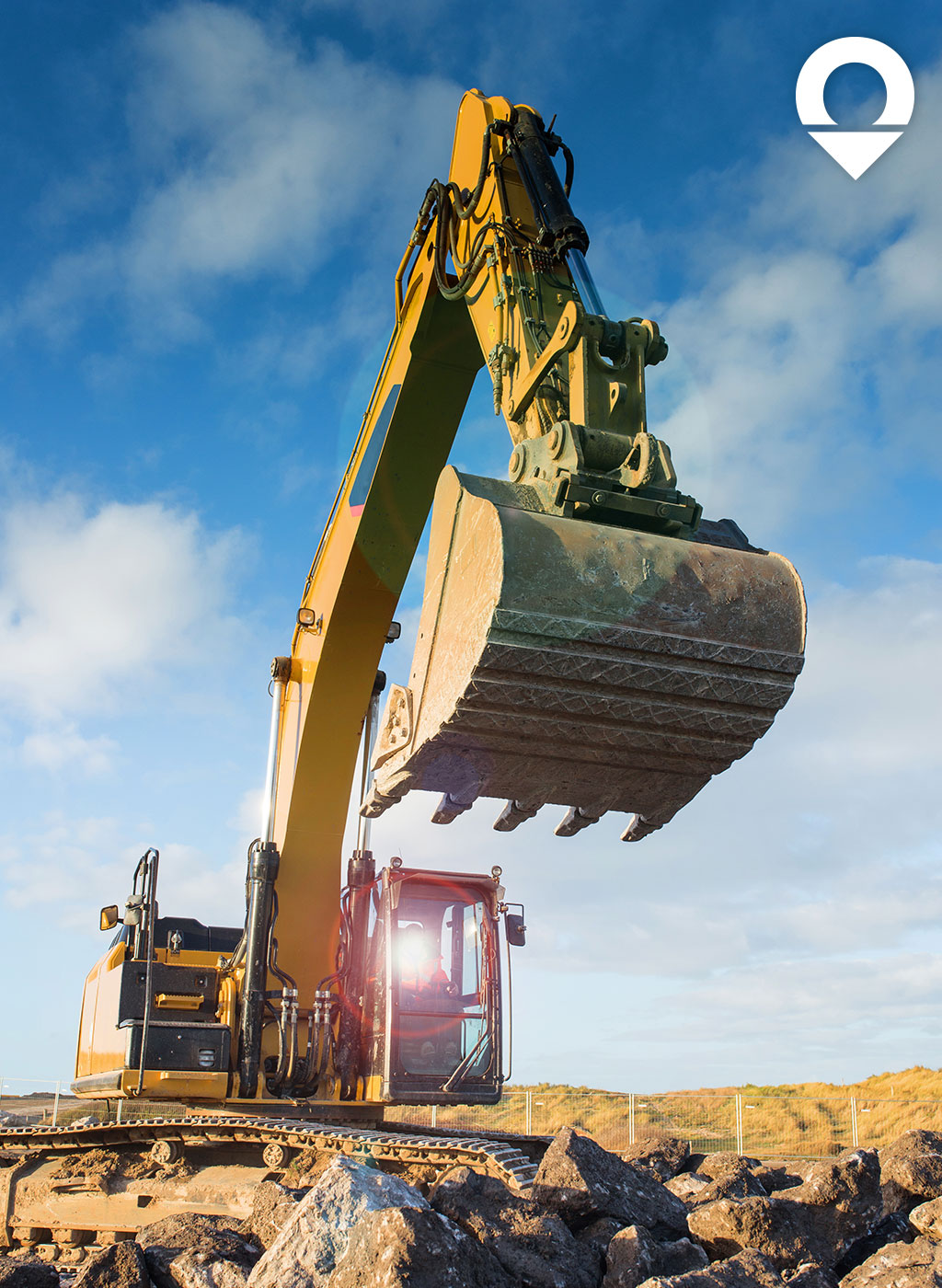
How to reduce the fuel consumption of your backhoe loader?
Organization and eco-driving
To effectively reduce your backhoe loader's fuel consumption, it's advisable to optimize the organization of each worksite to limit travel, which will directly impact its usage, of course. Furthermore, training in and adopting eco-driving techniquesis an excellent way to minimize your environmental impact and reduce energy waste.
This involves adopting a smooth driving style by anticipating the route to avoid sudden acceleration and braking. Eco-friendly drivingalso means maintaining a steady speed for the backhoe loader by avoiding prolonged stops whenever possible and switching off non-essential features such as air conditioning or daytime running lights when they are not needed.
Choosing the right construction equipment
To maximize the efficiency of a backhoe loader, it's essential to choose the model best suited to the specific needs of the project. Over-equipping is more common than you might think. Matching the power and size to the job site's requirements is a smart way to minimize negative externalities.
The importance of maintenance
Regular maintenance of any vehicle is of paramount importance, not least for safety and operator comfort, but especially to minimize fuel consumption by reducing wear and tear on parts. Be sure to change the oil and fuel filters regularly, particularly during periods of heavy use, to keep the engine clean and functioning properly.
Check the cooling system, hoses, and radiator for leaks, deformations, or cracks. The exhaust system must not be obstructed, as this reduces engine performance and increases harmful emissions.
The ECOLOW module for Public Works
The device we developed at ECOLOW is a technology that, in addition to all these practices, reduces fuel consumption by 12% to 15% for construction and forestry equipment. Numerous tests conducted over several years and the field results observed during our expansion confirm the effectiveness of our fuel-saving module.
The main advantage is that the system is considered an aftermarket accessory and, as such, does not affect the original equipment and therefore does not impact the manufacturer's warranty. Interchangeable and guaranteed, you can confidently install it on different vehicles in your fleet. Feel free to contact our team or visit our website for more information.